

How to find Alpha, Standard Deviation and Sharpe Ratio of Mutual Funds?
A decision to invest in mutual fund schemes must be preceded by an understanding of the fundamental criteria, that need to be weighed up and analysed, while selecting the scheme that is best suited for the investor, given the financial goals and risk appetite. The analytical tools that play an important part in determining the relative strengths of schemes offered by fund houses include the Alpha, Standard Deviation, Sharpe Ratio and Beta. We will understand the meaning of each of these terms and also discover the path for accessing all this information on the internet.
The risk free return referred to in the succeeding paragraphs is the 90 days Treasury Bills rate
Alpha
The Alpha of a mutual fund measures the performance of the fund in comparison with that of its benchmark index. The outcome is expressed in the form of a plain numeric but is actually a percentage calculation and is to be interpreted as a percentage.
The use of the Alpha as a tool for measuring the performance of mutual funds was introduced for the first time in 1968 by Michael Jensen.
Example :
If the Alpha of a fund is 7% it means that the fund has outperformed its benchmark index by 7%. The Alpha could also be negative e.g. -3% which would mean that the fund has delivered results inferior to that of the benchmark index by 3%.
Points to Note - Alpha Values
- For comparative purposes, Alpha should be used only to compare mutual fund schemes in the same class. Alpha of an equity fund should not be compared with that of a balanced fund.
- Because, the alpha calculation also includes the beta, it is possible that two funds with the same returns may have different alphas.
- As a rule of thumb, investors are advised to prefer the fund with a higher Alpha.
Standard Deviation
Standard deviation is a historical statistic that measures the extent to which the return from a fund varies from its mean (the average) over a specified period of time. Standard deviation can be measured over different periods of time and it is for the analyst to decide the period over which he wishes to measure the deviation.
A higher standard deviation is indicative of more volatile returns and the converse is true of a low standard deviation. Investors should ordinarily prefer schemes that have low standard deviation.
Sharpe Ratio
The Sharpe Ratio is a risk-return ratio named after its originator, Nobel Laureate Professor William F. Sharpe. The Sharpe ratio measures the risk adjusted performance of the fund with reference to the risk free return and its standard deviation.
A Sharpe Ratio of 1.27 would mean that for every unit of investment risk, the fund has generated 1.27 times of returns. The higher the Sharpe Ratio, the better the fund is as an investment prospect.
Beta
The beta of a mutual fund is a measure of its responsiveness to the movements in the benchmark index. The beta of the index is treated as 1. The excess return earned by a fund over the Treasury Bill rate is compared to the excess return earned by the benchmark index over the Treasury Bill rate.
Example :
A beta of 1.25 would mean that the performance of the fund is 25% better than the index in a rising market and 25% worse than the index in a falling market.
If the benchmark index had a return of 10% over a measured period
The fund return is expected to be 12.50% (10% + 2.5%).
25% of 10% = 2.5% which is added to the Bench mark Index.
Beta measures volatility solely in relation to market related risk.
How to find the values of Alpha, Standard Deviation & Sharpe Ratio
Visit to www.morningstar.in After log in, click on the ‘Tools’ button in the bar.

After you have clicked the ‘Tools’ button, a panel with the heading ‘Performance’ will appear on the left side of your screen. Move your cursor down to ‘Top Performing Funds’ in the list and click on that subject.
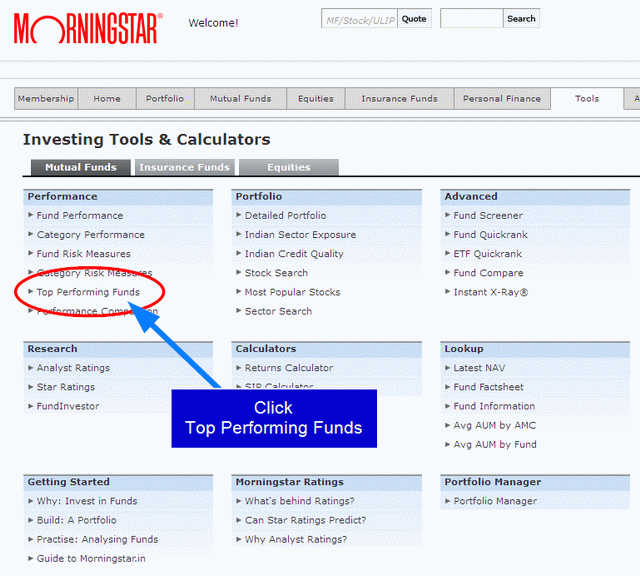
The next panel will have 4 subjects – Category, Time Period, Distribution Status and No. of Funds. First click on the drop down list for ‘Category’ and select the type of fund in which you are interested. In the image below, the ‘Category’ selected is ‘Flexicap’. You can select any type of Category depending upon your risk appetite.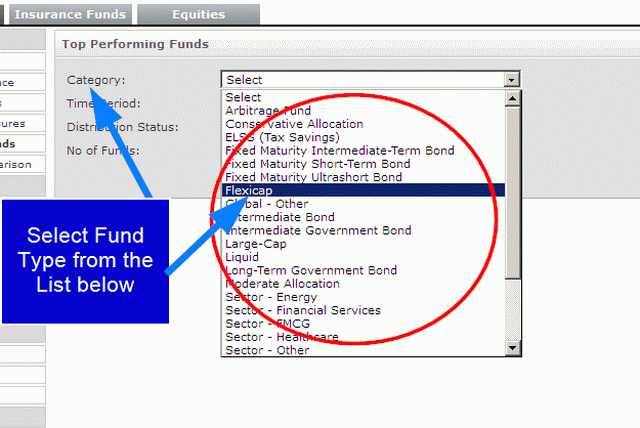
Next click on the drop down list for the ‘Time Period’ for which you would like to view data. The ‘Time Period’ ranges from 1 week to 10 years. In the image displayed, the selction has been made for 10 years.
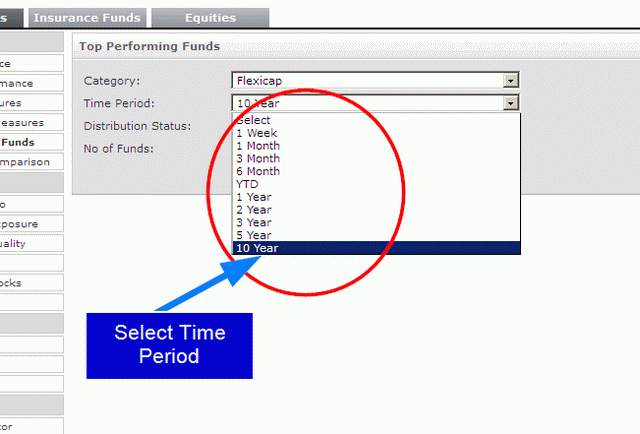
Now click on the drop down list for ‘Distribution Status’. The options available are ‘All’, ‘Growth’, and ‘Dividend’. In the image displayed below, the option selected is ‘Growth’.
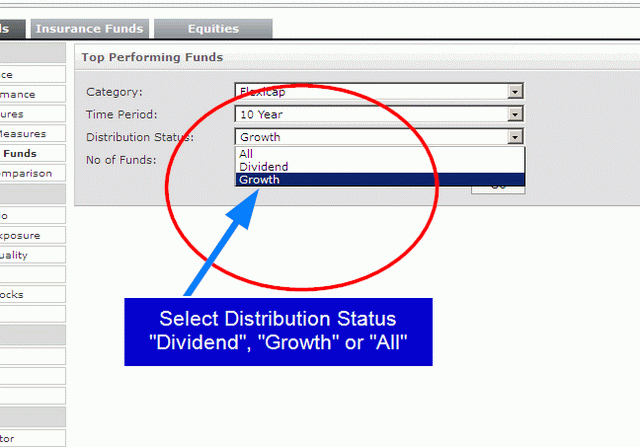
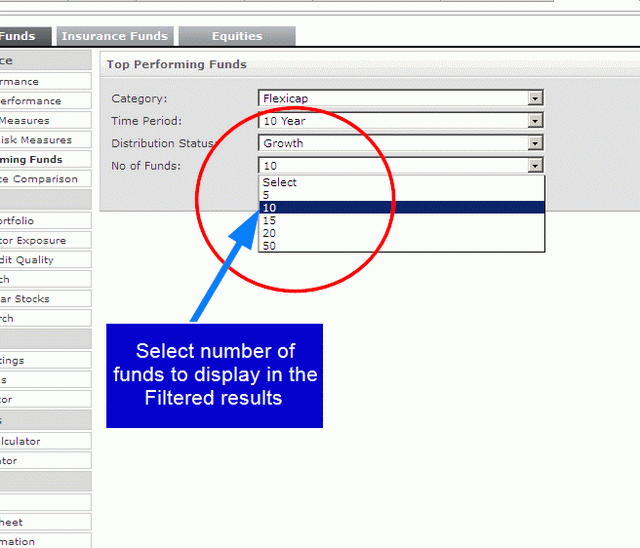
Next, from the drop down list for ‘No. of funds’, select the number of top performing funds for which you would like to view results. The selection available is 5, 10, 15, 20 and 50. In the image below, the option selected is 10.
Finally, click on the ‘Go’ bottom at the bottom of the panel.
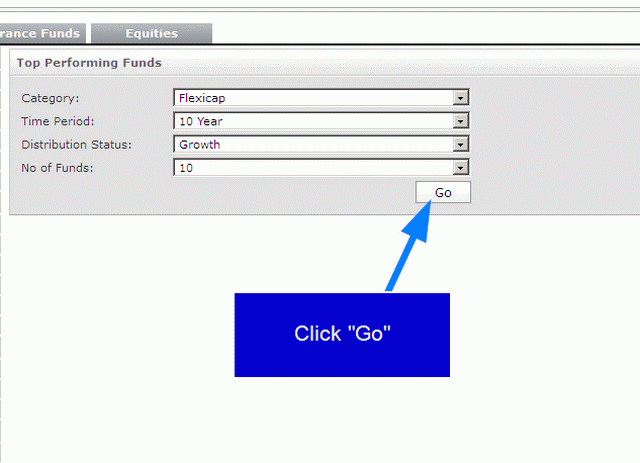
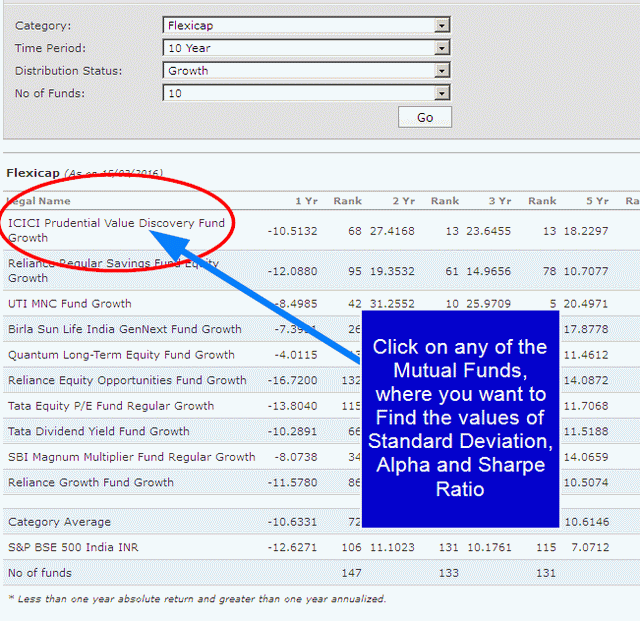
In the next screen, you will see a list of the top 10 performing funds with reference to the category, time period, and distribution status that you have selected. From the images above, you will see that we have searched for the top 10 (number) performing flexicap (category) growth (distribution status) funds for 10 years (time period).
The data displayed is as on date and shows the return and the rank. The top 10 positions are with reference to the current date. Now point the cursor at the particular fund for which you would like to view the Alpha, Beta, Standard Deviation and Sharpe Ratio and click. In the screen shot below, the fund selected for display of such data is the ICICI Prudential Value Discovery Fund Growth.
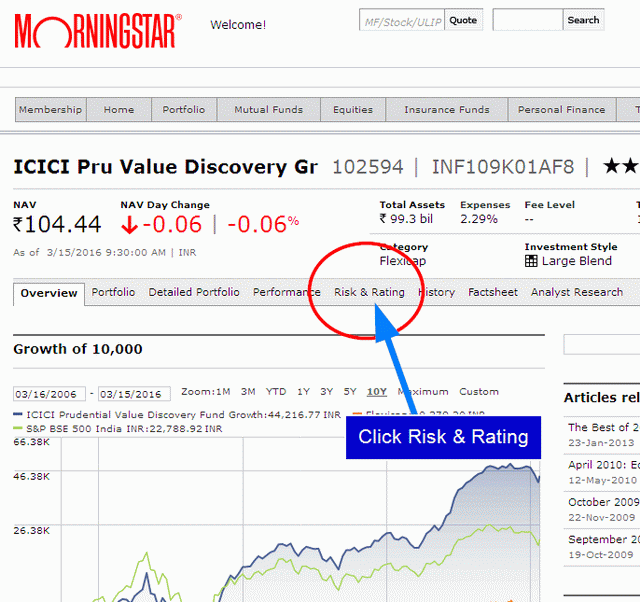
The next screen will display all the data related to the fund that has been selected; the ICICI Prudential Value Discovery Fund Growth. Click on the ‘Risk and Rating’ button in the bar as demonstrated in the image below.
In the next screen, scroll down to MPT Measures and Volatility Measures and select the period – 3 years, 5 years, 10 years or 15 years for which you would like to view results and click on the preferred tab. The fund return, its alpha, beta, standard deviation and Sharpe ratio are displayed. Comparative category data and that of the benchmark index (in the demonstrated case, it is the S&P BSE 500 Index) is also displayed.
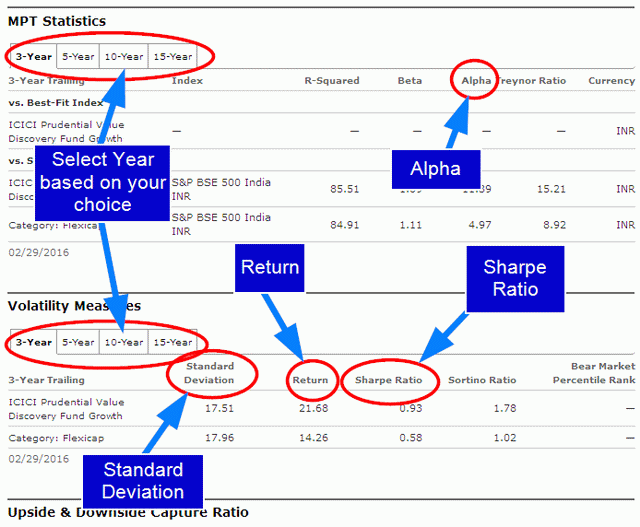
With this understanding of the terms Alpha, Beta, Standard Deviation and Sharpe Ratio, and the demonstrated ease of accessing the data for any fund on the internet, investors will be well informed and better equipped to make their decisions related to investment in mutual funds.
(This article provides general advice and recommendations and does not constitute personal advice. The opinions and examples in this article are for informational and educational purposes only. I have never invested in any of the funds named or displayed in this article. The statements in this article should not be construed as advice to invest in the funds named. Mutual fund investments are subject to market risks. Investors are advised to perform personal due diligence before investment. Readers are responsible for the decisions they take.)



















Wowww !!! this was the article that i was looking for…. Author has really taken all his experience & knowledge for letting us know all about mutual fund investing.These were really technical terms and I thought those are suited only in textbooks.but hey you can smartly use them in your investment strategy too.Author has also mentioned free screener where we can actually calculate the figures…. thanks & keep posting.